Shot at Dawn: The Fifteen Welshmen executed by the British Army in the First World War
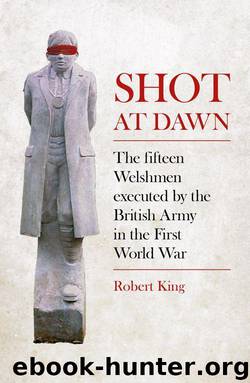
Author:Robert King
Language: eng
Format: mobi
ISBN: 9780750958820
Publisher: The History Press
Published: 2014-10-15T07:00:00+00:00
Official Report, House of Lords, 12 October 2006; Vol. 685, c.424.
This week we remember those service men and women who sacrificed their lives while serving their country in time of war. The First World War claimed many millions of lives, and I believe it is appropriate for us to take this opportunity to recognise some of the other victims of that war, namely those who were executed. I trust that the House will feel able to support the amendment, and bring closure to all the families who have had to live with the stigma of these executions in the period since the First World War.
Mr Gerald Howarth (Aldershot) (Con): I join the minister in paying tribute to the soldier from the Duke of Lancaster’s Regiment who has tragically lost his life in Iraq. I am sure that the minister reflected the views of the entire House in sending our condolences to his family.
No one can approach this subject without being moved by the terrible human tragedy involved in the cold execution of soldiers by their brothers-in-arms in the midst of one of the most epic battles in history. No one has done more than the hon. Member for Thurrock (Andrew Mackinlay) in bringing the issue before the House, as he has done persistently and tenaciously for the past thirteen years. I suspect that in the fullness of time this will come to be known as the Mackinlay amendment.
As Colonel John Hughes-Wilson wrote in the journal of the Royal United Services Institute:
There can be no one who is not moved by the chilling reality of soldiers, often young men who had volunteered to serve their King and country, being tied to a stake, blindfolded and shot by a firing squad, sometimes by comrades from their own regiment. It is an image that has entered the national consciousness and which tugs at the heart of any decent person.
Having said that, it is our duty as Parliamentarians to look as objectively and sensitively as we can at the facts and to assess whether the action proposed by the government in granting blanket pardons is correct, as that inevitably will have the effect of exonerating those who may well be deserving, but will also include those who, by any judgment, are not so deserving. In particular, I submit that we need to exercise great care in applying today’s standards to the conditions and mores of a century ago.
The facts are as stated by the Under-Secretary. As the Secretary of State’s predecessor, the current Home Secretary, pointed out to the House on 24 July 1998, between 4 August 1914 and 31 March 1920, approximately 20,000 personnel were convicted of military offences for which the death penalty could have been awarded. That does not include civilian capital offences such as murder. Of those 20,000, something over 3,000 were actually sentenced to death. Approximately 90 per cent of them escaped execution and 306 were actually executed. Each and every one of those is a personal tragedy for the soldiers, their families and their descendants.
Download
This site does not store any files on its server. We only index and link to content provided by other sites. Please contact the content providers to delete copyright contents if any and email us, we'll remove relevant links or contents immediately.
The Radium Girls by Kate Moore(12117)
100 Deadly Skills by Clint Emerson(4984)
Rise and Kill First by Ronen Bergman(4857)
The Templars by Dan Jones(4751)
The Doomsday Machine by Daniel Ellsberg(4576)
The Rape of Nanking by Iris Chang(4276)
Killing England by Bill O'Reilly(4065)
Stalin by Stephen Kotkin(4024)
Hitler in Los Angeles by Steven J. Ross(3993)
12 Strong by Doug Stanton(3590)
Hitler's Monsters by Eric Kurlander(3412)
The Code Book by Simon Singh(3269)
Blood and Sand by Alex Von Tunzelmann(3256)
Darkest Hour by Anthony McCarten(3184)
The Art of War Visualized by Jessica Hagy(3058)
Hitler's Flying Saucers: A Guide to German Flying Discs of the Second World War by Stevens Henry(2785)
Babylon's Ark by Lawrence Anthony(2744)
Tobruk by Peter Fitzsimons(2575)
The Second World Wars by Victor Davis Hanson(2559)
